
Copper, Copper-Plated or Bronze Garden Tools – What Is the Difference, Really?
Discover the difference between copper, copper-plated and bronze garden tools, and why bronze is the practical choice for durable, genuine copper garden tools.
When looking for garden tools made of copper, we can quickly come across terms such as “copper”, “partly copper”, “copper-plated”, “copper alloy” and “bronze”. At first glance, they may seem similar, but there are important differences between them.
With garden tools, the material is important not only because of its appearance. It determines the mechanical and chemical properties of the tool, its effect when in contact with soil, plants and water, its resistance to corrosion, and much more.
That is why, when comparing copper garden tools, the first thing to establish is what the tool is actually made of.
1. Tools made of pure copper
Pure copper is a very interesting metal. It is an excellent conductor, highly resistant to corrosion and, over time, develops a characteristic patina that protects the metal from deterioration.
However, pure copper has one important disadvantage for most garden tools: it is relatively soft.
When using a spade, hoe or a tool that is pushed into hard soil, we need a material that can withstand considerable mechanical stress. Pure copper can deform under such use.
For this reason, pure copper is more commonly used where its shape can be structurally supported or where mechanical strength is not as important.
At OJ Bron, one such example is the Svarog planting dibber. Its shape and construction allow the use of pure copper, while the working parts of most of our other garden tools are made from a copper alloy – bronze.
2. Copper-plated or copper-coated tools
A completely different story is a tool made of steel with a layer of copper on its surface.
Such a tool may look copper-like, but its base metal is still steel.
With galvanised or otherwise coated tools, an important question therefore arises: what happens when the coating wears away? Does it have any effect at all?
When working with soil, the working surface is constantly rubbed against sand, stones and other hard particles. The surface layer can therefore wear away quickly, and the base metal becomes exposed at the most heavily stressed areas.
This means that a “copper surface” and a “tool made of copper or a copper alloy” are not the same thing.
In addition, a coating may have an entirely different purpose – protecting the base metal from corrosion or simply improving its appearance.
By itself, a “copper-plated” tool does not have any of the properties attributed to copper, while a few microns of copper merely give the tool a nicer appearance rather than actual usability.
3. Tools made of several different metals – the question of galvanic cells
You may also come across tools made from several metals, such as copper and steel.
If two different metals are in contact and are simultaneously exposed to an electrolyte, a galvanic cell can form. Due to its water content and dissolved ions, moist soil can act as an electrolytic environment.
Different metals have different electrochemical potentials. One metal can become the anode and begin to dissolve more rapidly, while the other becomes the cathode.
This is a well-known phenomenon known as galvanic or bimetallic corrosion.
Therefore, when a tool is intended for prolonged contact with moist soil, it matters which metals are connected to each other and how they are connected.
This does not mean that every combination of different metals is problematic. In practice, the ratio between the metals, their surface areas, electrical contact, the presence of moisture, pH and the chemical composition of the environment are all important.
Likewise, when combining, for example, copper and steel, green verdigris can begin to form at their contact due to the galvanic cell, which is generally undesirable because of its toxicity.
Most importantly, in this case the + and – fields cancel each other out, while the central factor in the functioning of copper tools – the negatively charged copper ion – is lost.
4. What is bronze?
Bronze is not a different metal from copper, but a copper alloy.
The most classic bronze is an alloy of copper and tin. Adding tin significantly changes the mechanical properties of copper.
The result is a material that is harder and more suitable for making tools, while its fundamental metallic nature remains that of a copper alloy.
This is why bronze has been used for thousands of years to make tools and other objects where greater strength is required than pure copper can provide.
At OJ Bron, the working parts of most garden tools are made from bronze with a high copper content – approximately 86–94% copper, with the remainder consisting mainly of tin. The tools are also additionally hardened by forging.
This is an important difference.
We are not talking about a steel tool with a copper coating, but a tool whose working material itself is a copper alloy. This means that we benefit from all the advantages of copper in its interaction with soil, plants and water.
5. Why is a copper alloy particularly important for garden tools?
When using a tool in soil, we have both mechanical and chemical contact.
The mechanical aspect is fairly simple: the tool must penetrate the soil, remove weeds, loosen the soil and withstand repeated stresses in the process.
The chemical aspect is more complex.
Copper is a biologically active element. In small quantities, copper is an important micronutrient for plants and many organisms, but at higher concentrations its effects can be harmful.
This is an important point that needs to be stated clearly when discussing copper tools.
Research in agricultural soils shows that higher concentrations of copper can affect microbial communities and soil functionality. In a 12-year field experiment, concentrations above approximately 200 mg Cu/kg of soil were associated with more persistent changes in soil functionality and microbial communities. No such differences were observed at lower concentrations.
This means that the claim that “more copper is always better” is not scientifically justified.
With copper garden tools, however, we are dealing with a completely different way of introducing copper than through the deliberate addition of copper preparations or fertilisers to the soil.
During use, the tool wears on its working surface and may release very small quantities of material into the soil, which we refer to as traces of copper. How much copper actually enters the soil depends on numerous factors: the composition of the alloy, the surface area of the tool, the way it is used, the type of soil, moisture, acidity and frequency of use.
During use, the water in the soil is also ionised, which increases its surface tension. As a result, the soil retains water better, while it becomes more readily available to plants due to improved capillary action. In contrast to rust, which dries out the soil, soil worked with copper tools retains moisture better. This phenomenon was also documented in a Slovenian study by weighing soil samples. It is also immediately noticeable that working with such a tool is much easier, as friction through the soil is considerably lower. Over the years, bronze tools also become increasingly durable and tough, as each impact with the soil further hardens the material.
6. A particularly interesting example: the Slovenian study using the Zala tool
At OJ Bron, we also have more direct experience.
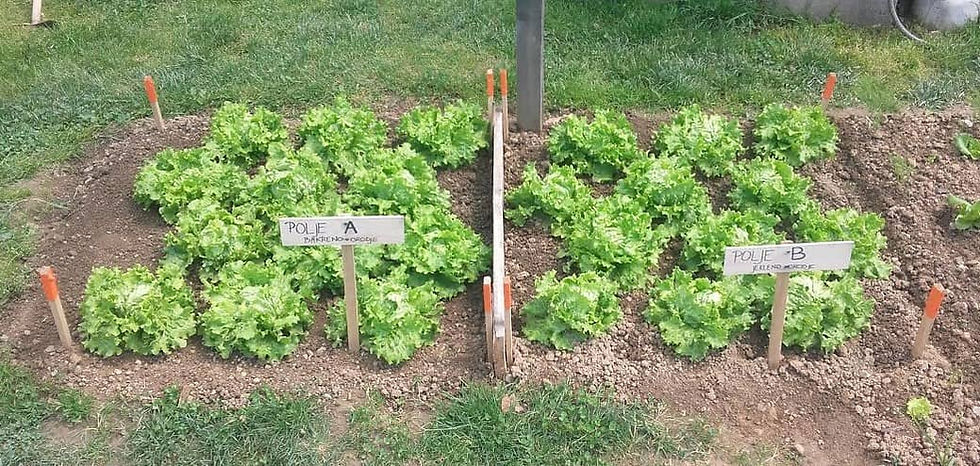
In 2017, our Zala tool was included in a thesis at the Faculty of Agriculture and Life Sciences of the University of Maribor. The study compared soil cultivation using copper and steel tools.
According to the data published together with the study, various soil properties were monitored over a period of several months. On the plot cultivated with the copper tool, differences were observed, among other things, in pH, water retention, potassium content, soil structure and the number of observed soil organisms.
7. So what are we actually buying?
When we see the term “copper garden tool” online, it is therefore sensible to ask a few simple questions:
Is the tool made of pure copper?
Is it made of a copper alloy, such as bronze?
Is the steel merely coated with copper?
What other metals is the tool made of?
With quality copper or bronze garden tools, it is important to know the actual composition of the material, and the OJ Bron brand guarantees the highest possible quality of copper garden tools with a 12-year warranty.
8. Copper alloy as a compromise between copper and strength
For making a useful garden tool, bronze is therefore a very interesting compromise.
Pure copper offers the properties of copper, but it is too soft for many heavily loaded parts.
Steel is very strong and suitable for heavy work, but iron corrodes and often has the opposite effect on soil, plants and water compared with copper tools.
Bronze, on the other hand, combines a high copper content with greater mechanical strength provided by the tin alloy and appropriate mechanical processing.
At OJ Bron, we therefore chose bronze for most of the parts that actually work in the soil. The composition of our parts is approximately 86–94% copper, with the remainder consisting mainly of tin, and the working parts are additionally hardened by forging.
This gives us a material that is neither “copper-painted steel” nor overly soft pure copper.
It is a copper alloy designed to allow us to actually work with it.
9. And what does patina mean?
Over time, patina develops on copper and bronze.
It is not rust.
It consists of basic surface products resulting from reactions between copper and its environment, which can form a protective layer on the surface of the metal. At OJ Bron, patina is therefore a normal part of the tool's lifespan and we generally do not remove it.
In fact, one of the interesting aspects of copper alloys is that such a tool does not lose its character through use, but gradually acquires a noble appearance.
Conclusion: not every “copper tool” is the same
Because of the reputation and prestige associated with copper, cheap shortcuts have appeared on the market that often attempt to convince customers, through a high price, that they are buying a genuine copper tool. Unfortunately, this is often not the case ...
Only the careful selection of the right copper alloy and the manufacturing process can provide the properties we want from a copper tool.
These include low friction during use, resistance to corrosion, longevity and durability, as well as a positive effect on soil, plants and water due to negatively charged copper ions.
When we want to buy a useful and long-lasting copper garden tool, the choice is very simple.
The term “copper garden tool” can refer to quite different things.
It can mean a tool made of pure copper.
It can mean a steel tool with a copper coating.
It can mean a tool made from several different metals.
Or it can mean a tool made from a solid copper alloy – bronze.
For the user, the most important thing is therefore to know what is actually hidden behind the term “copper”.
At OJ Bron, we chose a copper alloy – bronze with a high copper content – because it enables us to combine the properties of copper with the mechanical usability required for garden tools.
What remains interesting and worthy of further research is what happens during long-term, very low-level exposure to copper alloys during the actual use of garden tools.
And this is precisely where traditional knowledge of copper-tool making, the experience of gardeners and modern soil research meet.
OJ Bron was born at this intersection.



Comments